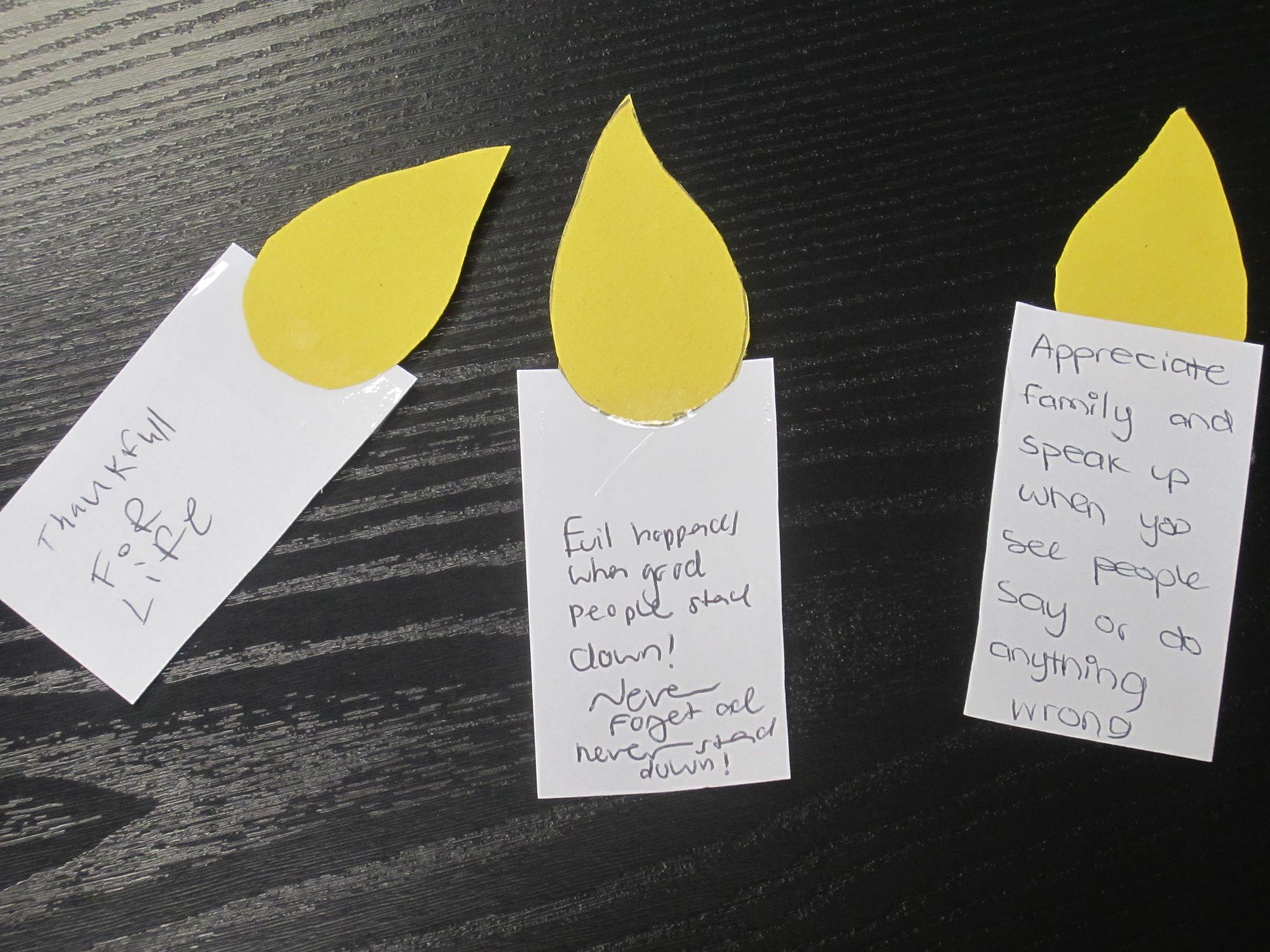
Marking Humanity Event at Barbara Frum Library – November 2011


Editor Shlomit Kriger connected with a mixed audience at Toronto’s Barbara Frum Library on Nov. 30, 2011 for the latest Marking Humanity Holocaust book event, which also featured survivors John Freund and Ghita Malvina. Both survivors faced extremely difficult situations at various concentration camps, including Auschwitz-Birkenau, and witnessed the brutal murder of many others. They have remained resilient and are spreading lessons from the Holocaust and messages of peace to others. In the words of 91-year-old Ghita Malvina, “Love, freedom, and friendship are the most important things in the world. Each person on Earth can and has to contribute something good in order to make our world safer.”

Share
 

Book Event at Sephardic Kehila Centre – June 2011


On June 21, 2011, an audience at the Sephardic Kehila Centre in Thornhill, Ontario, beared witness as Marking Humanity‘s editor, Shlomit Kriger, and two of the survivors featured in the book, Andy Réti and Sophie Soil, gave an intimate presentation about the Holocaust and its lessons at an event held by the Iraqi Jewish Association of Ontario. Both Andy and Sophie were young children during the Holocaust and have remained particularly struck by how the Nazi-perpetrated atrocities affected their parents. Andy showed a photo of his late mother, Ibi, as well as the wedding ring from Ibi’s first marriage to his father, who he never got to know. Although the Nazis confiscated jewellery and other valuables from the Jews, Ibi had managed to save the ring by hiding it in her baby’s diaper.

Share
 

Interview on ThatChannel’s Liquid Lunch Show – June 2, 2011


Editor Shlomit Kriger and one of the Holocaust survivors from Toronto featured in Marking Humanity, George Scott, were interviewed on the Liquid Lunch show on ThatChannel.com in Ontario, Canada, on June 2, 2011.

Born in Hungary in 1930, George Scott (originally Spiegel) was a teenager when the Nazis transported him to the Sarvar concentration camp and later to the Auschwitz-Birkenau camp in Poland. Although he survived the Holocaust, he lost five of his mother’s six sisters and all of their children and husbands, as well as his grandparents, who had raised him after his father died when he was only a year old. With aid from the Canadian Jewish Congress and other agencies that assisted child survivors, he made his way to Canada in 1948. After meeting Shlomit in 2008, full of zest for life and appreciation for what he had, he inspired her to collect writings from Holocaust survivors and was the first person to contribute pieces for Marking Humanity.

Click here to watch the interview (Length: 20 minutes)

Share
 

Aish Thornhill Holocaust Remembrance Event – May 1, 2011


On May 1, 2011, Holocaust Remembrance Day, the Aish Thornhill Community Shul in Ontario, Canada, held its third annual commemoration in memory of those lost and in honour of those who survived. Marking Humanity‘s editor, Shlomit Kriger, and three of the survivors featured in the book – Helen Drazek, George Scott, and Simcha Simchovitch – addressed the audience of about 250 people, educating and inspiring them with personal experiences and writings as well as some thoughts on the meaning of Never Again.

The Jewish Tribune included mention of this event in a recent article.

Click here to watch some highlights from the presentation

Share
 

Markham Arts Council Open Mic Night – March 2011


Marking Humanity‘s editor, Shlomit Kriger, read the poem ”Rosh Hashanah 1944 in Birkenau” by survivor George Scott at the Markham Arts Council’s first Open Mic Night, held in partnership with the Markham Village Writers on Mar. 24, 2011.

Share
 

“Overtime – Time and 1/2″ Arts Show in Toronto – February 2011


On Feb. 20, 2011, Marking Humanity‘s editor, Shlomit Kriger, shared some of the pieces by survivors featured in the book at the That’s Women’s Work Arts Network’s ”Overtime – Time and 1/2″ all-day arts show in Toronto, Canada. Check out SNAP Downtown Toronto for photos of some of the artists and artwork from this show.

Share
 

Na’amat Toronto Event – Jan. 24, 2011


Marking Humanity‘s editor, Shlomit Kriger, and two of the survivors featured in the book, Helen Drazek and Renate Krakauer, recently spoke at a Toronto, Ontario, chapter of Na’amat Canada. The all-female audience was very curious to find out about the survivors’ experiences during and after the Holocaust, while also discussing reflections on the past and its relevancy to the present.

Share
 

Remembrance Day Event in Ottawa November 2010


On November 11, Remembrance Day, Marking Humanity‘s editor, Shlomit Kriger, gave a presentation at the University of Ottawa in Ontario, Canada, and led a discussion with the students on some of the topics that were raised in her talk and some of the survivors’ pieces from the book.

Share
 

“Perspectives with Barry Shainbaum” Radio Interview – Nov. 7, 2010


Editor Shlomit Kriger and one of the Holocaust survivors from Toronto featured in Marking Humanity, John Freund, were interviewed on “Perspectives with Barry Shainbaum” on Faith FM (CJTW 94.3) in Kitchener, Ontario, on Nov. 7, 2010.

John was born in Czechoslovakia in June 1930. In 1942 the Nazis transported his family to the Terezin (Theresienstadt) ghetto, and at the end of 1943, to the Auschwitz-Birkenau camp in Poland. He ended up being one of about 35 boys who survived the camp, but he found only an aunt from his father’s side still alive when he returned to his hometown.

Click here to download / listen to the interview (Length: 1 hour)

Share
 

Marking Humanity Events October 2010


Marking Humanity‘s editor, Shlomit Kriger, and some of the featured survivors from Toronto, Canada – Renate Krakauer, George Scott, Simcha Simchovitch, Helen Drazek, and Frieda Traub (joined by her daughter Debi Traub) — connected with audience members ranging from youth to the elderly at two events in October 2010: at the Friends of Simon Wiesenthal Center on Oct. 18 and at The House on Oct. 28 (as part of Holocaust Education Week).

The survivors moved the audience with their stories and as they read their pieces from the book. Shlomit then shared her thoughts and research in relation to what people can learn from the survivors and the Holocaust, as well as how some of the core issues that played a role during that dark period in history are relevant in people’s own communities today. She emphasized that every person helps to shape the world and everyone can work on bettering themselves and their communities.

Share